

History Repeats Itself
Reflections on writing and AI technology
As many of you know, I alternate writing essays and short stories in English and Spanish in separate publications. I was recently invited to write an essay for a collaboration with Madrid-based writer Pedro Gala, and that was an honor I couldn’t pass-up.
At first, I had no idea what I wanted to write about. Then, I noticed a daily influx of articles by literary editors, writers, and publishers discussing the misuse of Artificial Intelligence text by unscrupulous individuals who’d publish stories and essays that are blatantly generated by AI, as if they had written it themselves. The harm this is causing is significant, and I don’t minimize the consequences of this practice:
Low-effort books saturate the market because it’s easy to publish them. This dilutes the marketplace and makes it hard for the work of authentic authors to be discovered.
Sales are diverted from legitimate writers to scammers through deception via stories they had no part in creating, fake biographies, copycat books and author names, unauthorized summaries, or workbooks that mimic popular authors’ styles or names.
Original work is exploited by AI Language Learning Models without compensation to the original authors, which devalues the writers’ economic viability.
Authenticity is eroded, literary standards are lowered, and genuine storytelling loses its value.
So then.
It ocurred to me that a lot of those articles conclude that any writer who uses AI tools whatsoever is deplorable and contributes to those (and more) problems. And those conclusions make me uncomfortable. Why? I’m a writer, and I’m a user of AI tools. Still, I recognize the problems as valid and in need of solutions.
I spent days trying to put into words my love-hate relationship with this subject. Then, a sandy backpack with my photo equipment gave me clarity and conviction. And when I finally sat down to write the essay for my collaboration with Pedro, my fingers typed furiously, the words flowed, and the article was published today.
Here’s the translation.
PEDRO
CM Torres is the author who brings us Tea, Book & Hammock, a reading space on Substack where fiction, poetry, essays, and texts converge and invite us to stop to take notice.
What I value most about her writing is this: she doesn’t publish out of obligation or for the sake of making noise, but only when a story truly deserves to be told. Her readers know that every piece arrives with intention and care.
A small community of readers has been gathering around her publications, engaging in conversations about literature with respect and curiosity.
Today I have the joy of sharing a collaboration with her.
I now leave you with her text.
ME
The Story Repeats Itself
by CM Torres
March. My favorite month has arrived. In the latitudes where I’ve been wandering in recent years, March is when the sun’s intensity begins to undress the mountains clad in white and begins blanketing them in green and spring colors.
The first day of the month was a Sunday. I was awakened by a chorus of seabirds screeching along the shore, and I looked out the window just as the sun peeked over the horizon. We greeted each other like old friends, and I said: “Sun, today I’m going to dedicate myself deep cleaning and getting organized,” and after a little café con leche, I tied my hair in a ponytail, put on comfortable clothes, and...
It didn’t go very well. Well, not in the sense of organizing and cleaning.
It turns out one of the first things I noticed was that I’d left my backpack with my photo gear on a shelf for a long time without touching it. So I grabbed an archaeologist’s brush and took it outside to brush off the sand that had accumulated on it, remembering that I’d done something similar last year. And the year before.
I opened the backpack. My soul ached! The Canon digital camera. Specialized lenses. Macro, 55mm, 70-300mm, telephoto, filters, batteries, and memory cards with photos from another decade that I hadn’t looked at since I took them. To clarify: I haven’t stopped taking photos, but lately I take most of them with my phone. And I rarely print them or look at them again. They end up lost in a sea of other silly images (that I should delete), but together they get transferred to an external computer drive. At this point, finding my photos worthy of gallery exhibition is like mining for emeralds.
What on earth has happened to my passion for photography? I remember the little pocket cameras my family had when I was a girl in Puerto Rico. I’d walk half a mile to the town pharmacy to drop off rolls for developing. Two weeks later, I’d go back to pick up the envelope with the Kodak logo and my mom’s name handwritten on it. Inside were negatives and photos of picnics, birthdays, first day of school, Christmases, parties, or family gatherings. The ones that weren’t blurry (or missing heads) were kept in photo albums, and we stored the negatives in a box in case anyone wanted copies.
I remember sitting with the albums on weekends to reminisce about those moments. Sometimes alone. Sometimes with my siblings or friends.
As a teenager, I was obsessed with one of my sisters’ Minolta camera. She taught me how to open it, load the roll correctly, and how to focus and adjust according to the lighting and film speed. How to read through the little window how many shots were left. She taught me that if you opened the door before fully rewinding the negative, you’d ruin the roll.
I remember my first Canon camera.
In my thirties, I’d invent photographic safaris with my best friend from the office, and we’d take spectacular photos that we printed on glossy paper. At that age, with so many things demanding my attention, I’d leave them stored with the negatives inside the envelopes, thinking that one day I’d buy new albums to organize them. I remember moving from house to house when I had work transfers. Packing and unpacking the old albums and the boxes where I’d accumulated dozens of Kodak envelopes with photos and negatives.
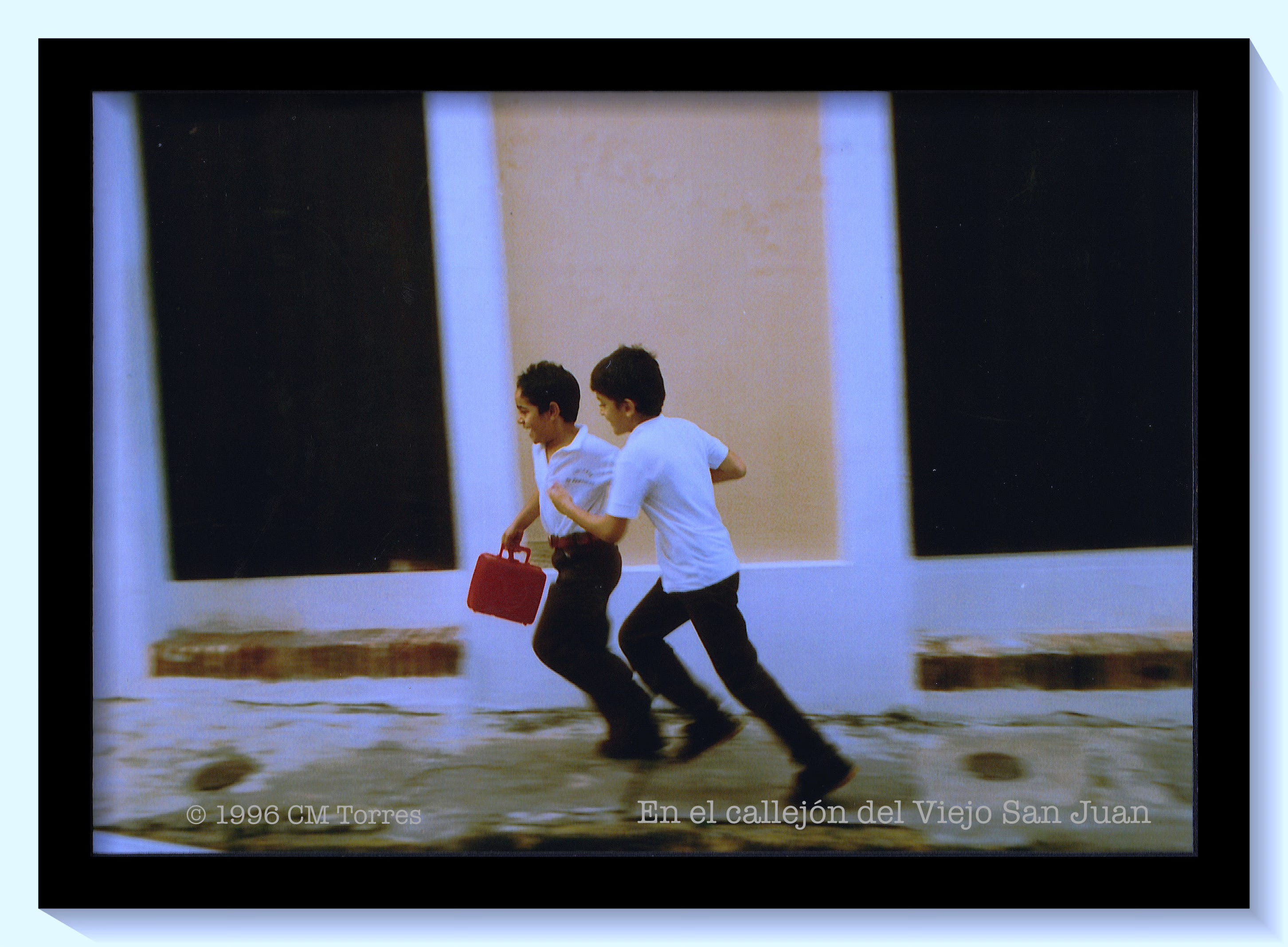
I traveled to Puerto Rico before moving to a job in Alaska. I shot 15 rolls of film across the island to remember my homeland when the polar winter hit hard. I titled my favorite photo En el callejón del Viejo San Juan. That photo won first place in an international Kodak contest. It was exhibited in the Journey to the Imagination pavilion at Epcot Center and in the National Geographic headquarters offices in Washington, D.C.
Oh, the achievements!
Photography became an integral part of my identity until digital cameras arrived. I joined other True Photographers in protest against those impostor little cameras. The ones that self-focus. The ones that stabilize the image when the photographer can’t stop moving. The ones that can take hundreds of photos in fifteen minutes. No rolls. No negatives. No talent. The lack of talent, easily compensated with apps like Photoshop.
It took some time, but eventually I bought a digital Canon and over time learned to be happy with the new photos, no matter that those who master retouching technology better than I can produce images just as impressive—or more—without having artistic talent.
At some point, I started writing more and photographing less. With a lot of dedication and imagination, I’ve published short stories and essays in English and Spanish. I also edit a digital literary magazine tited Piscolabis.
Now they call me an author.
I reached a new summit, and right behind me came artificial intelligence with its language learning models that give instant answers to any kind of question or query. It can even write complete novels for naïve readers.
The story—technology invading creative spaces—repeats itself.
But this time, instead of getting indignant and rejecting new tools, I didn’t delay in adapting. I start my new stories by writing conscientiously, with soul, using my imagination. Then, I cautiously use AI tools to refine my writing in the same way I once used dictionaries, encyclopedias, and technical and history books.
It’s a controversial topic, but it’s worth remembering that writing fiction conscientiously and with soul is something inimitable, singular, and spontaneous. It goes beyond what’s expected; beyond the perfected techniques of artificial intelligence. It’s an imperfect interpretation of what the writer senses in real and imagined worlds, expressed with raw honesty through words. In the end, having soul and conscience means embodying an authentic emotional truth and a human—truly human—depth that moves others beyond the superficial or artificial.
Precisely because of that, I’m not opposed to these tools. In my hands, artificial intelligence doesn’t replace my voice. It amplifies it. It helps me polish, explore paths my mind alone wouldn’t have seen so quickly, and free up time for what really matters: feeling, living, and translating those emotions onto the page. History repeats itself, yes, but this time I write with my heart, using technology as a complement. And in that alliance, something new is born: a freer, bolder creativity that is, above all, more human than ever.
PEDRO
After reading CM Torres, one beautiful idea lingers:
Creative passions change form, but they rarely disappear.
Sometimes they transform.
Sometimes they shift from the camera to writing.
Or from the page to conversation with readers.
Her reflection on photography, memory, and technology reminds us of something important: tools change, but what gives meaning to what we do remains profoundly human. It has been a true pleasure opening La Casa Azul to welcome her.
Thank you, CM Torres, for sharing your reflection, your story, and your way of understanding creativity in these times when technology advances as fast as our questions.
The doors of this house remain open for you, whenever you want to return.
If you’d like to keep reading CM Torres, you can visit her home page on Substack: Tea, Book & Hammock. The good reading spaces always end up finding each other.
To read the original collaboration (in Spanish) here: La historia se repite
Sign-up for my Spanish Publication here: Puño y Letra
Your essay resonated with me. I never use AI to write for me, but I do use it to help me organize my thoughts, provide a template for larger pieces, and bounce ideas off of. I really like it as emotional support — yes, I know it's not real, but I enjoy all its positive affirmations. As you say, I use it as a tool, not as a replacement for my own work.
I found I was nodding my head in agreement an awful lot as I read this piece. Although I have not won any awards, I enjoy photography. I have fallen into the habit of using my phone for photos, especially of the grandkids. I learned much about photography while in the Peace Corps. Opportunities were plentiful, but the cost of developing the photos kept the number down, so I paid attention to things like f-stops, lighting, etc.
I still write, mostly poems, short fiction, and I finished my novel last fall after five years plus. I did win an award, not first place, for a poem. Unfortunately, I am not bilingual. Well, not well enough to publish for sure.
Anyway, I connected with your article. Enjoyed it.
I invite you and any others who read this to subscribe to my publication, Pen Whisperer. ringstorm.substack.com
Thanks.
Tim Williams